
Most teams choose a deployment strategy once, early in the project, based on what the team lead knew at the time. Then they keep using it long after the system's risk profile, traffic patterns, and team size have changed. A strategy that was fine for a monolith serving internal users becomes a liability when that same service handles external transactions at scale.
Blue-green, canary, and rolling are not interchangeable tools at different complexity levels. Each makes a different bet about where the risk lives: infrastructure cost, observability overhead, or rollback complexity. Getting the choice wrong shapes what a bad deployment actually looks like when it happens.
This article covers what each strategy costs in production, where each breaks, and how to match the strategy to the service type rather than team convention.
What Deployment Strategy Choice Actually Involves
Before comparing the three strategies, two things need to be established that most explanations skip.
First, Kubernetes does not natively give you blue-green or canary deployments. It gives you rolling updates as the default. Implementing blue-green or canary correctly on Kubernetes requires either a service mesh (Istio, Linkerd), an ingress controller with traffic-weighting support (NGINX, Traefik, AWS ALB), or a dedicated progressive delivery tool (Argo Rollouts, Flagger). Teams that believe they are running canary deployments because their CI pipeline gradually replaces pods are often just running a slow rolling update with no traffic control.
Second, the deployment strategy is inseparable from the rollback strategy. A deployment approach that cannot be reversed in under five minutes is not a safe deployment approach, it is an optimistic one. The choice of deployment strategy should start with "how fast can we undo this?" rather than "how do we get the new version out?"
Blue-Green Deployment: Full Environment Swap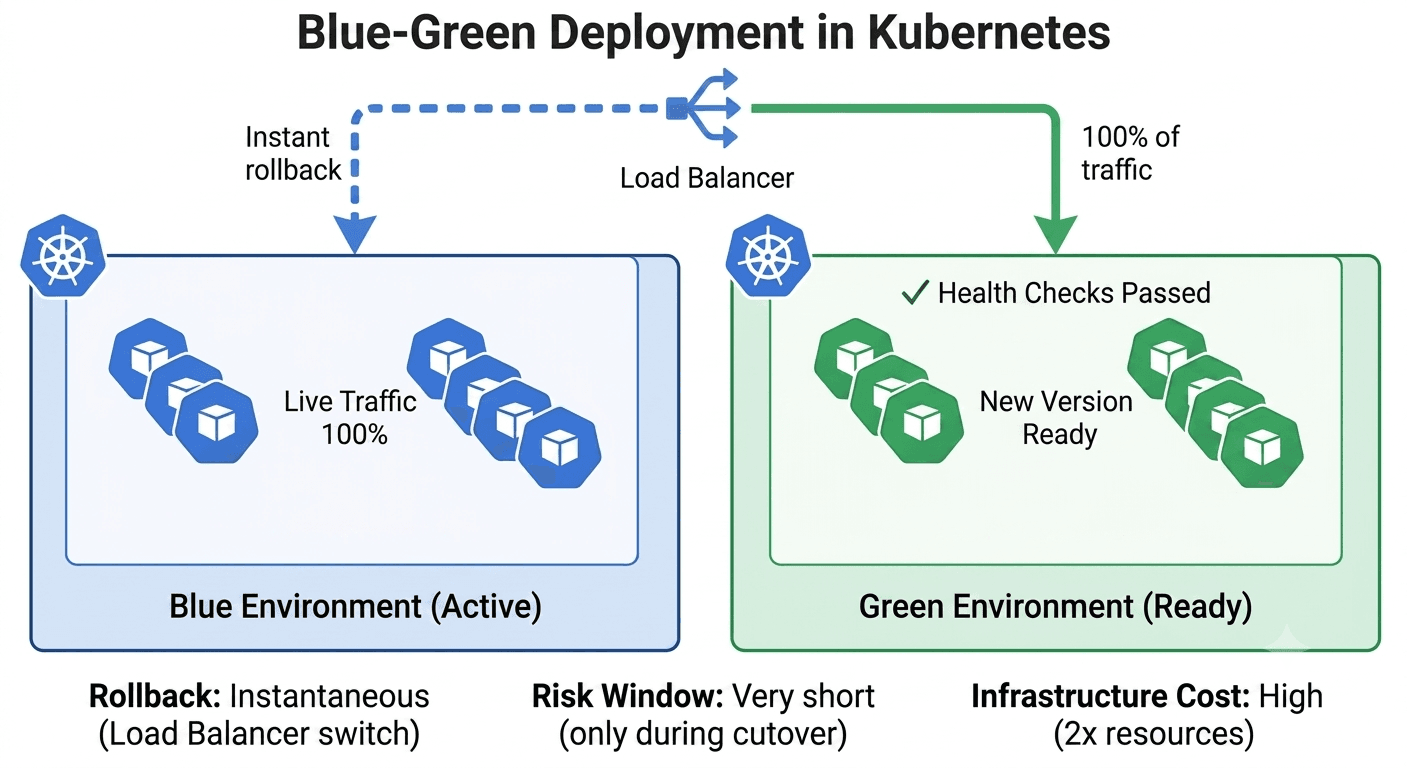
Fig 1: Blue-Green Deployment - Two parallel environments with instant traffic switch and rollback.
Blue-green deployment runs two identical production environments simultaneously. The "blue" environment serves live traffic. The "green" environment receives the new version. When the green environment passes all checks,traffic switches from blue to green at the load balancer or ingress level. Blue becomes the standby.
The appeal is obvious: rollback is instant. If green fails after cutover, switch traffic back to blue. No partial state, no incremental cleanup. The entire rollback is a single load balancer rule change.
The production reality is more constrained. Blue-green doubles your infrastructure cost for the duration of the deployment window. For organizations running large GPU clusters or memory-heavy services, this is not a rounding error. More critically, blue-green handles database schema changes poorly. If the new version requires a schema migration that is not backward-compatible with the old version, you cannot simply switch back to blue after the migration runs. This means blue-green deployments either require carefully designed backward-compatible schema changes or a separate database migration strategy that runs independently of the deployment.
The second failure mode is the "big bang" cutover risk. Blue-green moves 100% of traffic simultaneously. A bug that only manifests under specific user behaviors or traffic patterns will hit every user at once rather than a small percentage. Despite the instant rollback capability, the window between cutover and problem detection can be wide enough to cause real damage.
When it works well: Stateless services with no database schema coupling. Compliance-driven environments requiring a verified clean-room for each release. Any situation where rollback speed matters more than the cost of running parallel infrastructure.
When it breaks: Stateful services with shared databases and non-backward-compatible schema changes. Cost-sensitive infrastructure where doubling resource consumption during deployments is not viable. Services where failure modes are traffic-pattern-specific and require gradual exposure to detect.
Canary Deployment: Controlled Traffic Shifting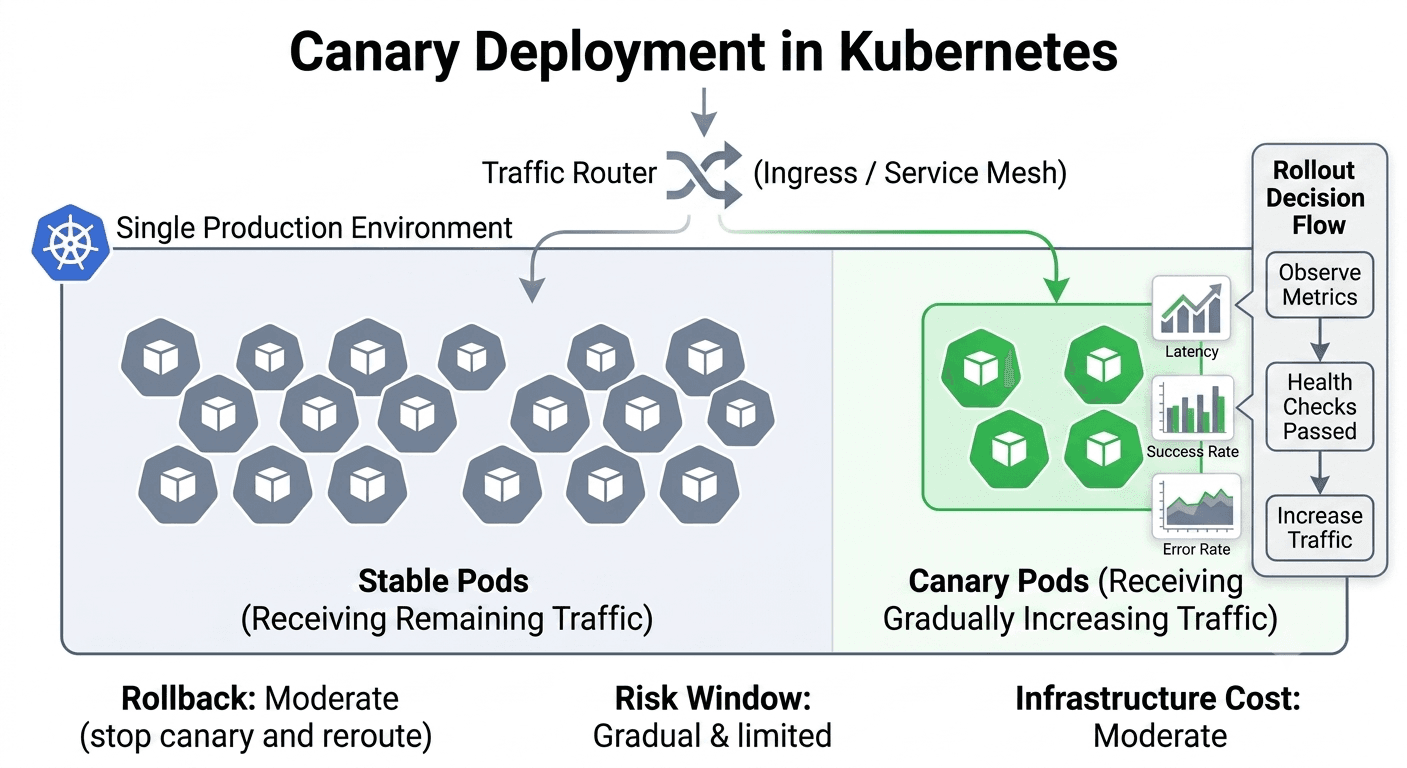
Fig 2: Canary Deployment - Gradual traffic shifting to new pods with monitoring.
Canary deployment routes a small percentage of live traffic (typically 1-5%) to the new version while the majority continues on the stable version.The percentage shifts upward as the new version proves itself against real traffic, with promotion decisions based on health checks and predefined success criteria such as error rate, latency, and request success rate. Traffic gradually increases from a small percentage until the new version receives 100% of production traffic.
The correct mental model for canary is not "gradual rollout." It is "controlled experiment." The value of a canary is not in being cautious. It is in detecting failure modes that only appear under real user traffic, real data, and real concurrency patterns that no staging environment faithfully replicates. A canary that nobody monitors is not a safety mechanism. It is a slow rolling deployment with extra infrastructure complexity.
The production requirement this creates is direct: canary deployments only work if you have the observability infrastructure to compare the canary version against the baseline in real time. This means per-version metrics, not aggregate cluster metrics. You need to know that the canary pods have a 400ms p99 latency compared to 120ms on the stable version before you scale the canary to 25%. If your monitoring stack cannot tell you that, the canary is providing false confidence.
The Kubernetes implementation gap matters here. The native Kubernetes Deployment controller does not support percentage-based traffic splitting. A "canary" implemented by running a handful of new pods alongside old ones achieves traffic splitting by pod ratio, which is imprecise and breaks down at low traffic percentages. Precise canary requires ingress-level traffic weighting or a service mesh. Argo Rollouts and Flagger implement this correctly, with analysis runs that automate promotion or rollback based on metrics.
When it works well: High-traffic consumer-facing services where real user exposure is the only reliable test environment. Teams with automated promotion gates based on error rate and latency SLOs. Services with rich per-version observability.
When it breaks: Low-traffic services where a 5% canary receives too few requests to detect statistical failure within a useful timeframe. Services without per-version observability, where canary monitoring reduces to checking cluster-level aggregates. Monolithic services with shared state that behaves differently at partial versus full traffic.
Rolling Deployment: Default Kubernetes Behavior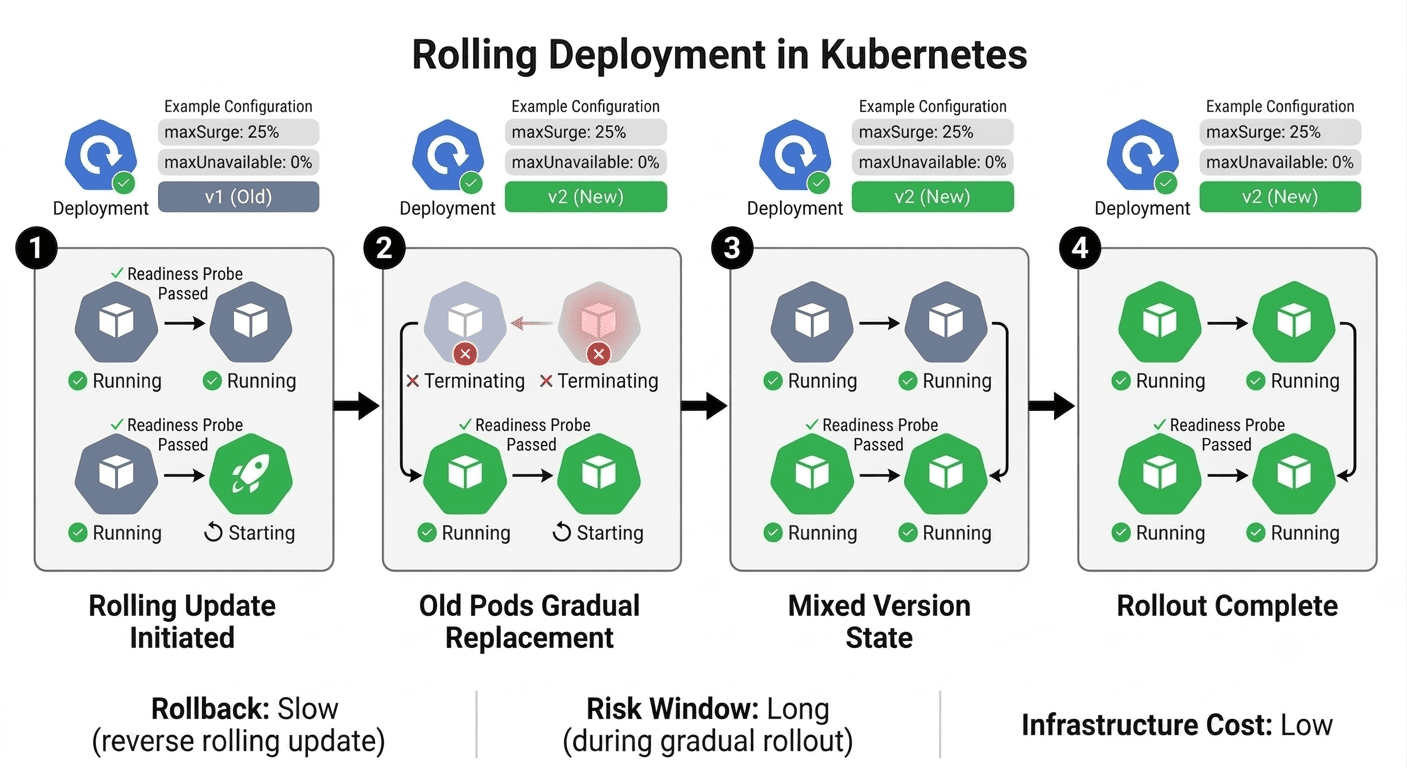
Fig 3: Rolling Deployment - Incremental pod-by-pod replacement in Kubernetes.
Rolling deployment replaces instances of the old version with instances of the new version incrementally. Kubernetes implements this natively through the Deployment resource: the Deployment controller gradually replaces old pods with new ones in batches, governed by maxSurge and maxUnavailable settings. The process continues until all pods run the new version.
Rolling is the right default for a specific class of service: stateless, horizontally scalable applications where two versions of the code can coexist briefly without conflict. For that class of service, rolling is operationally simple, requires no additional infrastructure, and limits the blast radius of a bad deployment to the percentage of pods already updated.
The failure modes emerge at the edges. During a rolling deployment, both versions of your service are running simultaneously. If the new version introduces a breaking API change or an incompatible data format, requests hitting old pods and requests hitting new pods return different responses. Clients routing across both versions encounter inconsistent behavior. This is the most common source of mysterious production incidents during deployments: not the new version failing outright, but old and new versions interacting incorrectly with shared queues, caches, or databases.
Rollback in rolling deployments is also not as clean as it appears. Rolling back re-triggers the same gradual process in reverse. A contaminated cache or database state written by the new version still affects the rollback. Rolling back stops new writes in the wrong format; it does not reset existing ones.
When it works well: Stateless API services where both versions are backward-compatible at the protocol and data level. Teams that need zero additional infrastructure overhead and can accept incremental risk exposure during the deployment window.
When it breaks: Stateful services or services with version-specific persistent state. Any service where old and new pods cannot safely coexist. Scenarios where fast, clean rollback matters more than minimizing infrastructure cost.
The Problem None of Them Solve Cleanly: Database Changes
Deployment strategy discussions almost always focus on application code. The harder problem is the database layer, and it is where the choice of deployment strategy has the most consequences.
Blue-green, canary, and rolling all assume the new version of your application can run against the same database as the old version, at least temporarily. When that assumption breaks, the deployment strategy breaks with it.
Rolling and canary deployments run both versions simultaneously by design. If your new version requires a column rename, a schema constraint change, or a non-nullable column addition, requests hitting old pods and new pods will produce different behavior against the same database. The result is not a clean failure. It is inconsistent behavior that is difficult to attribute and harder to roll back cleanly.
Blue-green avoids the mixed-version problem during normal operation because only one environment handles traffic at a time. But it does not avoid schema risk at cutover. If a migration runs before traffic switches to green and the cutover fails for an unrelated reason, rolling back to blue means running the old code against the already-migrated schema.
The production pattern that handles this correctly is the expand-contract migration (also called parallel change). It runs in three phases: first, expand the schema to support both the old and new application behavior simultaneously; second, deploy the new application version; third, contract the schema by removing the old columns or constraints once the old version is no longer running. This approach works with all three deployment strategies because neither version ever requires a schema state the other cannot tolerate.
The practical implication: your deployment strategy and your database migration strategy need to be designed together, not independently. A canary deployment with a non-backward-compatible schema migration is not a safer release. It is a slower incident.
Comparison: Blue-Green vs Canary vs Rolling
The following comparison summarizes the operational differences between the three deployment strategies discussed above.
| Dimension | Blue-Green | Canary | Rolling |
| Traffic Control | Full cutover (0% or 100%) | Precise % split (1-99%) | Pod replacement (no traffic weighting) |
| Rollback Speed | Immediate (load balancer flip) | Fast (route back to stable) | Slow (re-deploys in reverse) |
| Infrastructure Cost | 2x during deployment | Low overhead | Minimal overhead |
| Observability Needed | Low (pass/fail gate) | High (per-version metrics) | Medium (aggregate metrics) |
| Database Handling | Risky with schema changes | Requires backward-compat | Requires backward-compat |
| Native Kubernetes | No (needs LB config) | No (needs ingress/service mesh) | Yes (default Deployment) |
| Best For | Stateless + fast rollback | High-traffic + observability | Stateless + low complexity |
| Primary Risk | Big-bang blast radius | False safety without metrics | Mixed-version coexistence |
How to Choose: Match Strategy to Service Type
The deployment strategy should follow the service's risk profile, not team convention.
Start with your rollback requirement. If you need to undo a deployment in under two minutes with zero residual state from the bad version, blue-green is the only strategy that achieves this. If you can tolerate a few minutes of rollback execution, canary and rolling both work. This question often resolves the choice before the others need to be asked.
Assess your observability maturity. Canary deployments require per-version metric comparison to provide value. If your monitoring stack only gives you cluster-level or service-level aggregates, a canary gives you false confidence. Either invest in per-version observability before adopting canary, or use a strategy that matches your current monitoring capability.
Check whether your versions can coexist. Rolling and canary both require the old and new versions to coexist safely for the duration of the deployment. This means backward-compatible APIs, shared caches that tolerate both data formats, and database schemas that both versions can read and write without conflict. If your release introduces a breaking change at any of these layers, the only safe deployment strategy is blue-green with a coordinated cutover, or a staged migration that decouples the schema change from the code deployment.
Factor in your traffic volume. Canary deployments need enough traffic for the canary slice to receive statistically meaningful request counts in a reasonable window. A service handling 100 requests per day will not surface a latency regression at a 5% canary within any useful timeframe. For low-traffic services, blue-green or rolling is operationally simpler without sacrificing meaningful safety.
Consider your infrastructure cost tolerance. Blue-green doubles your compute footprint during the deployment window. For services with significant resource consumption, this is a real cost, not a rounding error. Canary adds ingress or service mesh complexity. Rolling adds no infrastructure overhead. Cost is rarely the primary criterion but matters for high-frequency deployments on large services.
Engineering Challenges in Production
The most common failure across all three strategies is treating deployment strategy as a CI/CD configuration rather than a production operations decision. A strategy only functions correctly when paired with the right observability, rollback procedures, and database migration approach. Without those, the choice is cosmetic.
The second most common failure is neglecting the fourth option: feature flags. Many situations that teams reach for blue-green or canary to solve are better handled by deploying new code to all instances behind a flag, then enabling it gradually for user segments. This decouples deployment risk from release risk, a more powerful separation than any deployment strategy provides alone.
Kubernetes-native teams should default to Argo Rollouts or Flagger for blue-green and canary rather than manually managing ingress weights and replica counts. Both tools implement analysis runs that automate the promotion or rollback decision based on Prometheus metrics, reducing the surface for human error.
Key Takeaways
- Blue-green provides instant rollback but doubles infrastructure cost and concentrates all risk at the cutover moment.
- Canary limits blast radius but requires per-version observability to provide real safety rather than false confidence.
- Rolling is the right default for stateless, backward-compatible services, and the wrong choice when versions cannot coexist.
- None of the three strategies handles database schema changes cleanly without additional coordination.
- Feature flags decouple deployment risk from release risk and are underused relative to their value.
- Match the strategy to the service's rollback requirement, not team convention.
Frequently Asked Questions (FAQs)
Q1: What is the difference between blue-green and canary deployment?
Blue-green switches 100% of traffic at a single point in time, providing instant rollback by switching back to the previous environment. Canary routes a small percentage of live traffic to the new version and shifts it upward gradually, limiting blast radius by detecting failures before full promotion.
Q2: Is rolling deployment safe for production?
Rolling deployment is safe for stateless services where old and new versions can coexist at the API, cache, and database levels without conflict. It is risky when versions cannot safely coexist or when you need a fast, clean rollback, because rolling back re-triggers the same gradual process in reverse.
Q3: Does Kubernetes support canary deployments natively?
No. Kubernetes' default Deployment controller implements rolling updates. Canary requires ingress-level traffic weighting, a service mesh, or a progressive delivery tool like Argo Rollouts or Flagger. Pod-ratio canary is imprecise and breaks down at low traffic percentages.
Q4: When should you use blue-green deployment?
Blue-green is the right choice when rollback speed is the primary concern, when the new environment can be fully verified before cutover, or when compliance requirements mandate a clean-room release. It is poorly suited to services with non-backward-compatible database schema changes.
Q5: What is the role of feature flags alongside deployment strategies?
Feature flags decouple deployment from release: you deploy new code to all instances without exposing the feature to users, then enable it gradually through a control plane. This separates infrastructure risk (the deployment) from user-facing release risk (the flag), reducing blast radius regardless of which deployment strategy you use.

