
1. Introduction
Multi-agent AI systems are becoming a core pattern for enterprise AI workloads. Instead of relying on a single model to perform every task, organizations are increasingly splitting responsibilities across specialized agents that can collaborate, share context, and execute tools independently.
This shift improves modularity, task specialization, and workflow efficiency. As these systems grow more complex, infrastructure becomes a critical factor.
Google Vertex AI provides a managed cloud-native foundation for building and scaling these multi-agent systems. With integrated model access, orchestration capabilities, and production-grade infrastructure, it supports modern agent-based workflows at scale.
2. Understanding Multi-Agent Systems in AI
A multi-agent system is an architecture where multiple AI agents work together to complete complex tasks. Each agent usually has a specialized role, allowing the system to break larger workflows into smaller and more manageable operations.
For example:
| Planner Agent → Task Breakdown Retriever Agent → Context Gathering Executor Agent → Tool Execution Validator Agent → Output Verification |
This separation improves efficiency because each agent focuses on a narrower responsibility instead of handling the entire workflow.
In traditional single-agent architectures, one model is responsible for planning, retrieval, tool execution, and response generation. While this works for simple tasks, it becomes inefficient as workflows grow more complex because one overloaded model handles too many responsibilities.
Multi-agent systems solve this by distributing responsibilities across specialized agents. Instead of one large workflow, multiple agents collaborate based on their assigned expertise.
This model improves task parallelism, strengthens fault isolation, enables better tool specialization, and creates more flexible workflow execution.
It also improves reliability because if one agent fails, the entire workflow does not necessarily stop.
In enterprise environments, these architectures are increasingly used for customer support automation, cloud infrastructure operations, code generation pipelines, AI copilots, and workflow orchestration systems where tasks need to be delegated dynamically.
3. Why Google Vertex AI for Multi-Agent Systems
Building multi-agent systems requires more than access to large language models. It demands orchestration, scalability, security, and infrastructure consistency across multiple execution layers. As agent-based workflows become more complex, managing these layers manually can quickly increase operational overhead.
Google Vertex AI provides a managed foundation for building these systems by combining model access, infrastructure services, and orchestration capabilities within a unified cloud environment.
For teams evaluating managed AI platforms, our 2025 analysis of Google Vertex AI, Amazon Bedrock, and Azure OpenAI offers a broader platform-level comparison before moving into multi-agent implementation patterns. That comparison highlights where Vertex AI stands across model access, integrations, and enterprise readiness, while this blog focuses specifically on multi-agent architecture and operational scaling.
This makes it easier to build agent workflows that rely on cloud-native storage, data systems, and scalable compute services without introducing separate infrastructure layers.
Some of the most important advantages of Vertex AI for multi-agent systems include:
| Capability | Vertex AI Benefit |
| Gemini Models | Native multimodal reasoning for agent workflows |
| BigQuery Integration | Direct access to enterprise-scale data processing |
| Cloud Run / GKE | Flexible execution for distributed agents |
| Vertex AI Agent Engine | Managed orchestration for agent lifecycles |
These capabilities make Google Vertex AI multi-agent systems more practical for production deployment because they reduce infrastructure complexity while improving execution consistency across specialized agents.
4. Core Architecture of Multi-Agent Systems on Vertex AI
A multi-agent AI architecture on Vertex AI usually separates agents into specialized execution layers. Instead of one centralized intelligence layer, multiple agents collaborate across independent tasks.
A common structure looks like:
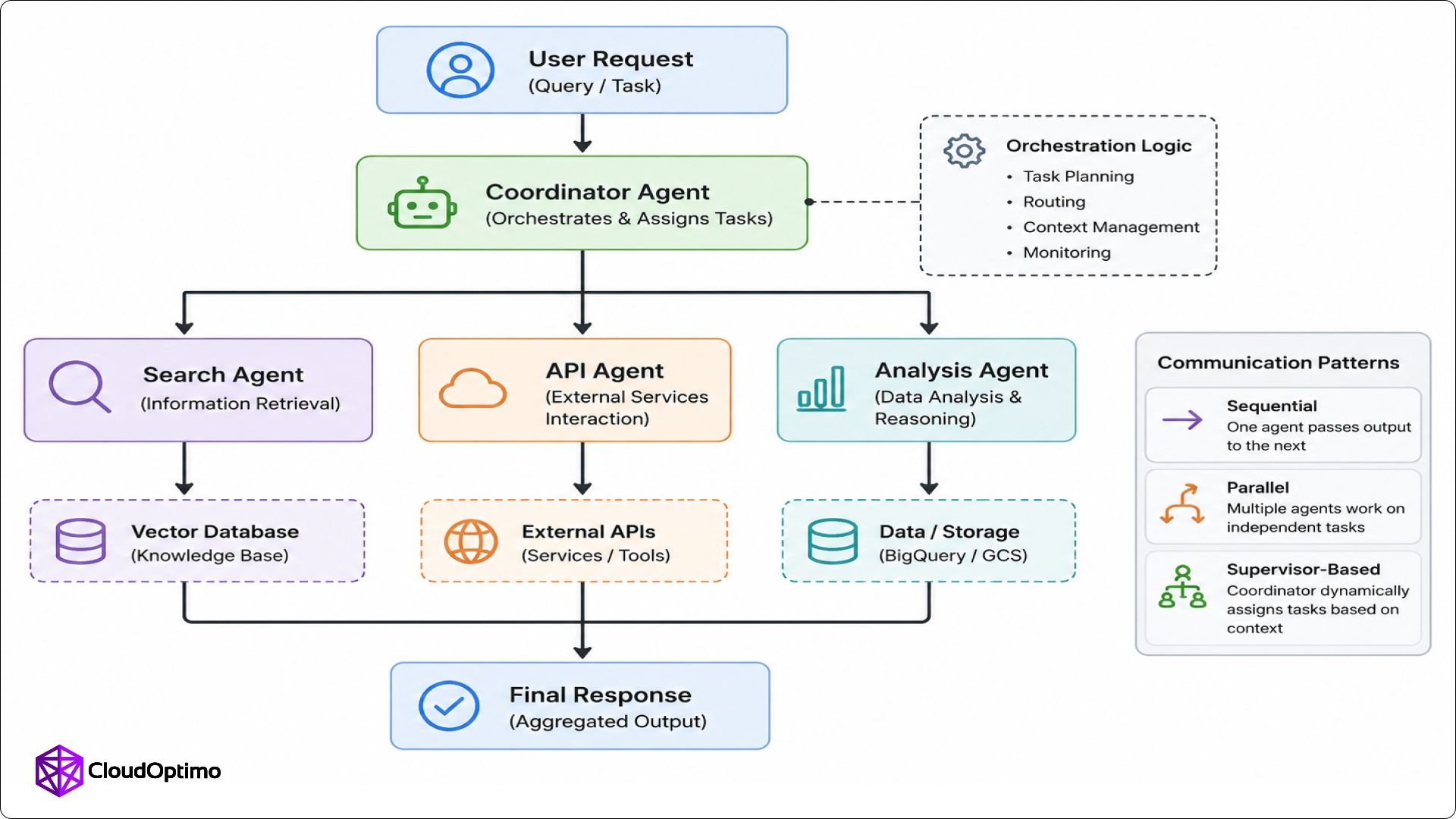
This architecture supports parallel execution, specialized tooling, and isolated state handling, which makes multi-agent workflows more modular and easier to scale.
Vertex AI allows these agents to run independently while maintaining clear execution boundaries, making multi-agent workflows easier to scale and manage.
A critical part of this model is communication between agents. Different workflows use different communication patterns depending on task complexity.
In sequential patterns, one agent passes output directly to the next agent. This works well for dependent tasks such as retrieval followed by summarization.
In parallel execution, multiple agents run simultaneously on independent subtasks. This improves speed for workloads where tasks do not depend on each other.
Supervisor-based architectures introduce a central coordinator that dynamically assigns tasks based on context and execution status. This is often used in production systems where workloads change dynamically.
This flexibility makes Vertex AI agent architecture more adaptable for enterprise-scale multi-agent systems.
5. Agent Engine in Vertex AI
The Vertex AI Agent Engine acts as the execution layer for multi-agent workflows. It manages how agents are triggered, how tasks are distributed, and how responses are processed across the workflow.
Instead of manually managing each agent lifecycle, Agent Engine coordinates task execution, model invocation, tool access, and response flow within a unified execution framework.
A typical execution lifecycle:
| Input → Agent Trigger → Tool Call → Response Processing → Output |
This simplifies operational overhead by standardizing execution patterns.
Agent Engine also improves lifecycle management. In multi-agent systems, tasks often depend on intermediate outputs. Agent Engine maintains these dependencies and ensures the next agent receives the correct input.
Failure recovery is another important capability. If one agent fails during execution, retry mechanisms can restart only the failed task instead of restarting the entire workflow.
This improves fault isolation and reduces unnecessary compute waste.
For larger deployments, Agent Engine supports workload distribution across multiple execution instances. This allows agent workloads to scale horizontally while maintaining consistent orchestration.
As Vertex AI Agent Engine becomes more central to multi-agent systems, it provides the foundation for scalable agent execution in production.
6. Tool Orchestration for Multi-Agent Systems
Tool orchestration is one of the most important layers in multi-agent systems because agents often depend on external APIs, databases, and infrastructure tools to complete tasks.
Different agents often require different tools depending on their responsibilities. A search agent may use internal APIs, a deployment agent may interact with CI/CD pipelines, and a monitoring agent may rely on observability platforms.
Vertex AI enables structured tool orchestration by separating tool logic from agent logic. This prevents every agent from maintaining duplicate integrations and creates a cleaner execution model.
A common shared tool layer looks like:
| Agent A → Search API Agent B → Search API Agent C → Monitoring API |
Shared tool layers improve efficiency because multiple agents can reuse the same APIs without rebuilding connectors independently. This reduces engineering duplication and improves consistency across workflows.
Structured AI tool orchestration becomes increasingly important as multi-agent systems expand because shared tools directly influence execution consistency across agents.
7. State Handling in Multi-Agent Workflows
State handling determines how agents maintain continuity between tasks.
There are two common types:
| State Type | Purpose |
| Session State | Temporary workflow context |
| Persistent State | Long-term task continuity |
Without proper state handling, agents may lose progress, repeat tasks, or generate inconsistent outputs.
In multi-agent systems, shared state allows agents to continue workflows without losing execution history.
For example:
| Agent A completes retrieval State stored Agent B resumes using stored context |
This improves workflow continuity.
However, distributed state handling introduces challenges.
One common issue is stale state. An agent may reference outdated workflow data while another agent has already updated it.
Another issue is duplicate execution. If multiple agents read incomplete state information, they may perform the same task multiple times.
Race conditions can also occur when multiple agents update shared state simultaneously.
To avoid these issues, production systems often use centralized state stores, versioning systems, or transactional state layers to maintain consistency across agent workflows.
Strong state handling in AI agents is essential for reliable execution.
8. Memory Layers in Multi-Agent Architectures
Memory layers allow agents to retain, retrieve, and reuse information across workflows. In multi-agent systems, memory is essential because not every agent should start from zero context.
While state handling manages active workflow continuity, memory layers manage knowledge persistence beyond the active execution lifecycle.
Memory is usually divided into two layers.
1. Short-Term Memory
Short-term memory stores active session context. This includes recent prompts, tool outputs, intermediate decisions, and temporary workflow data. This memory helps agents continue tasks without losing immediate workflow context.
2. Long-Term Memory
Long-term memory stores historical knowledge that can be reused across multiple sessions. This may include previous workflow history, stored documentation, historical agent decisions, and user-specific preferences that help agents maintain long-term contextual continuity.
In production, memory layers in AI systems often use vector databases as the long-term retrieval layer.
A common memory retrieval model looks like:
| Agent Request ↓ Vector Database ↓ Relevant Historical Context ↓ Agent Response |
This improves contextual awareness by allowing agents to retrieve relevant knowledge without rebuilding context from scratch.
Another important pattern is shared memory across multiple agents. Instead of maintaining isolated memory stores, a centralized memory layer allows multiple agents to access common operational history.
This becomes especially useful in long-running workflows where multiple agents depend on shared knowledge to maintain continuity across tasks.
Efficient memory design improves response quality, reduces duplicated work, and increases workflow consistency across distributed agent systems.
9. Multi-Agent Routing and Coordination
Multi-agent routing determines how tasks are assigned across specialized agents.
Without routing logic, agents may receive tasks they are not designed to handle, which creates inefficiencies and execution delays.
A common routing model looks like:
| User Request ↓ Supervisor Agent ↓ Specialized Agents |
The supervisor agent decides task ownership, execution order, retry logic, and failover behavior. This improves coordination and workflow accuracy.
Multi-agent routing generally follows three execution patterns. Sequential routing is used when one task depends on the output of another. Parallel routing allows multiple agents to execute independently at the same time, improving speed for isolated tasks. Dynamic routing introduces a supervisor layer that decides task flow based on live context and workload conditions.
For example:
| Input Analysis → Choose Agent → Execute Task → Validate Result |
This model is often used in enterprise systems where workload patterns change constantly.
Strong multi-agent routing improves execution efficiency by reducing delays, balancing workloads, and improving task accuracy.
10. Scaling Multi-Agent Systems on Vertex AI
Scaling multi-agent systems is more complex than scaling traditional AI APIs because multiple agents often execute at the same time across independent workflows. This increases compute usage, tool invocations, memory retrieval operations, and routing overhead, making infrastructure planning much more important.
Google Vertex AI supports horizontal scaling for agent workloads by distributing execution across multiple compute instances. This allows agent workflows to scale based on concurrency rather than relying on fixed execution capacity. As agent-based systems grow, this becomes critical for handling parallel workloads, larger memory retrieval patterns, and higher tool usage across distributed services.
Scaling multi-agent systems also depends on the underlying ML infrastructure. In our 2024 cloud ML platform comparison covering SageMaker, Azure ML, and Google AI Platform, we examined how managed AI platforms differ in deployment flexibility, orchestration depth, and scaling behavior. Those differences become even more important when multi-agent systems require independent execution layers, memory services, and shared tool orchestration.
A common production scaling model often follows this flow:
| Incoming Requests ↓ Load Balancer ↓ Agent Pool ↓ Tool Layer |
This model allows requests to be distributed dynamically across available agent instances, improving throughput and reducing execution bottlenecks.
The most important scaling areas usually include:
| Area | Optimization |
| Agent Execution | Horizontal scaling |
| Memory Retrieval | Vector caching |
| Tool Calls | Parallel execution |
| Routing | Load balancing |
Scaling is not only about compute expansion. Teams must also manage token consumption across agents, concurrency limits, retry volumes, and API quotas. Without proper controls, multi-agent systems can become expensive and difficult to optimize.
Efficient scaling improves latency, throughput, and infrastructure utilization across Vertex AI agent workflows, making it a critical part of production-ready multi-agent architecture.
11. Observability and Governance for Multi-Agent Systems
Observability becomes critical as multi-agent systems become more distributed. Unlike single-agent systems, multiple execution paths now exist inside one workflow.
Teams need clear visibility into agent ownership, tool execution paths, memory access patterns, and failure points across the workflow.
In production environments, teams usually monitor agent latency, tool failures, memory retrieval efficiency, and routing accuracy. Together, these signals provide visibility into execution quality and help improve operational debugging.
A common execution flow looks like:
| Request → Coordinator → Agent → Tool → Output |
This helps identify failures quickly.
If a workflow fails, tracing shows whether the issue occurred during task routing, tool execution, memory retrieval, or output validation.
Governance is equally important because multi-agent systems often interact with multiple tools and services.
Production governance usually includes access policies, audit logs, execution permissions, and compliance controls. This improves reliability and operational control.
Strong observability and governance help teams maintain trust, performance, and stability as Google Vertex AI multi-agent systems scale.
12. Frequently Asked Questions (FAQ)
1. Why do my agents keep repeating the same task?
This often happens when state is not persisted correctly between execution steps. Without shared state, agents may restart workflows instead of continuing.
2. Why is tool execution slower in multi-agent systems?
Latency increases when multiple agents access tools sequentially instead of in parallel. Tool orchestration efficiency directly affects response time.
3. How should memory be shared across agents?
Short-term memory should remain task-specific, while long-term memory can be shared through vector databases for broader context retrieval.
4. What causes routing failures in multi-agent workflows?
Routing failures usually happen when supervisor logic lacks clear task boundaries, causing the wrong agent to receive requests.

