
Serverless computing has become a common architecture for applications that need flexible execution without directly managing servers. Two prominent options are Cloudflare Workers and AWS Lambda, but they approach serverless execution from different infrastructure models.
Cloudflare Workers runs application code on Cloudflare's global network, while AWS Lambda provides event-driven serverless compute integrated deeply with AWS services. Both platforms can support APIs, backend logic, scheduled tasks, and event-driven workloads, yet their differences in runtime, networking, storage, scaling, and cloud integration can make one a better fit for a particular application.
Choosing between Cloudflare Workers and AWS Lambda therefore depends less on which platform has more features and more on where the workload runs, how it communicates with other services, and what operational model the organization wants.
Cloudflare Workers and AWS Lambda: What Are They?
Cloudflare Workers is a serverless application platform designed to execute code across Cloudflare's global network. It supports JavaScript, TypeScript, Python, Rust, and other supported languages, and can be used for full-stack applications, APIs, request processing, and edge logic.
AWS Lambda is an event-driven serverless compute service that runs application code without requiring teams to provision or maintain servers. Lambda integrates with AWS services and can be invoked through API requests, storage events, queues, scheduled events, and other triggers.
The core distinction is architectural. Cloudflare Workers is optimized around globally distributed edge execution, while AWS Lambda is designed as a broader cloud compute service deeply integrated with AWS infrastructure.
That difference influences how applications handle requests, connect to data, manage regional resources, and scale across workloads.
Cloudflare Workers vs AWS Lambda Architecture
The execution model is the first major difference to consider.
Cloudflare Workers executes code on Cloudflare's distributed network rather than relying on a traditional centralized server location. Requests can therefore be handled close to users, making the platform particularly relevant for applications where request latency and global distribution are important.
AWS Lambda abstracts server management while integrating execution with AWS infrastructure. A Lambda function can be invoked directly or through services such as Amazon API Gateway, Amazon S3, Amazon SQS, and EventBridge. AWS manages capacity provisioning, scaling, patching, and the underlying execution environments.
A simplified architecture looks like this:
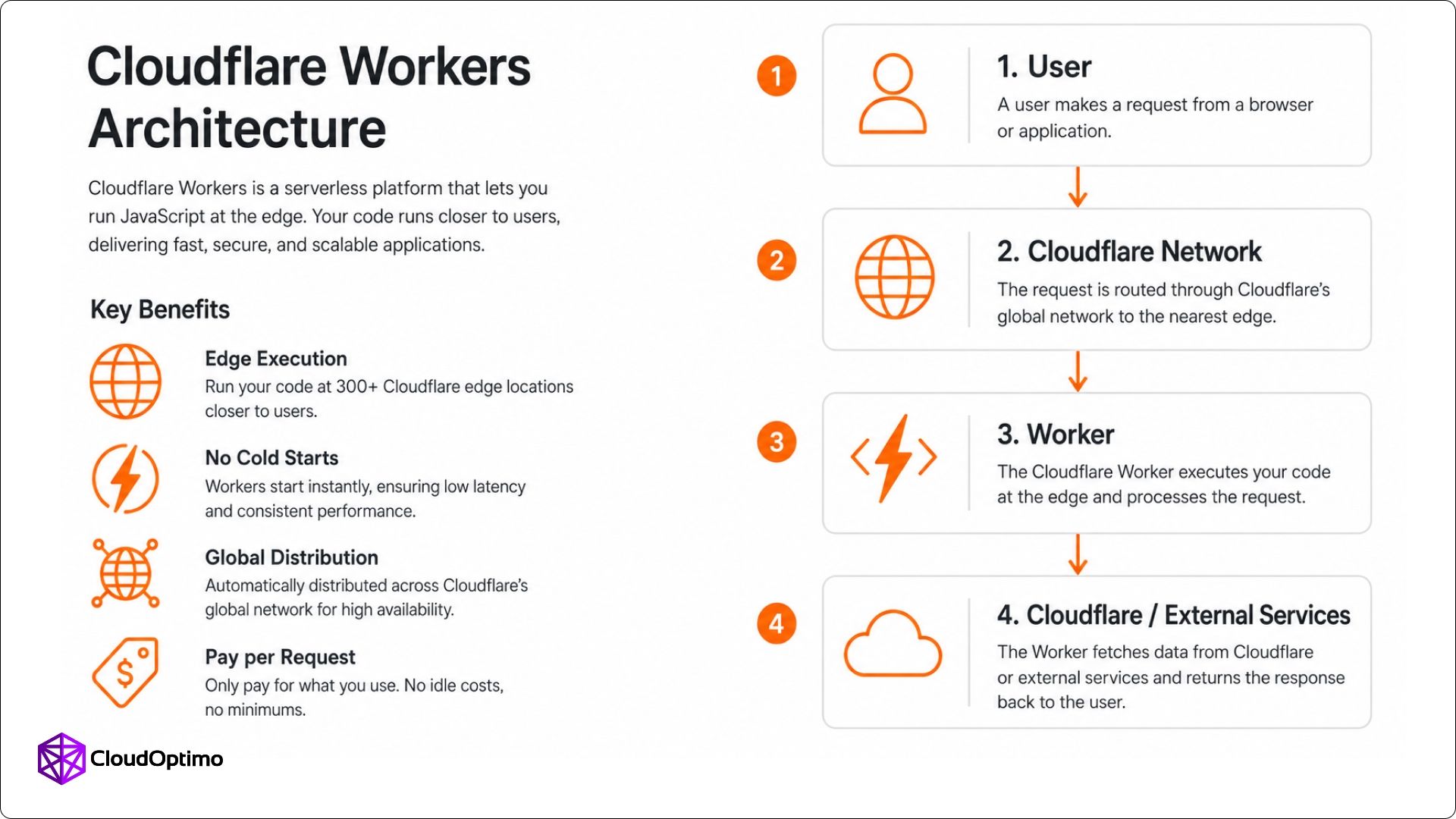
Figure : A simplified request flow through User, Cloudflare Network, Worker, and External Services in a serverless edge execution architecture.
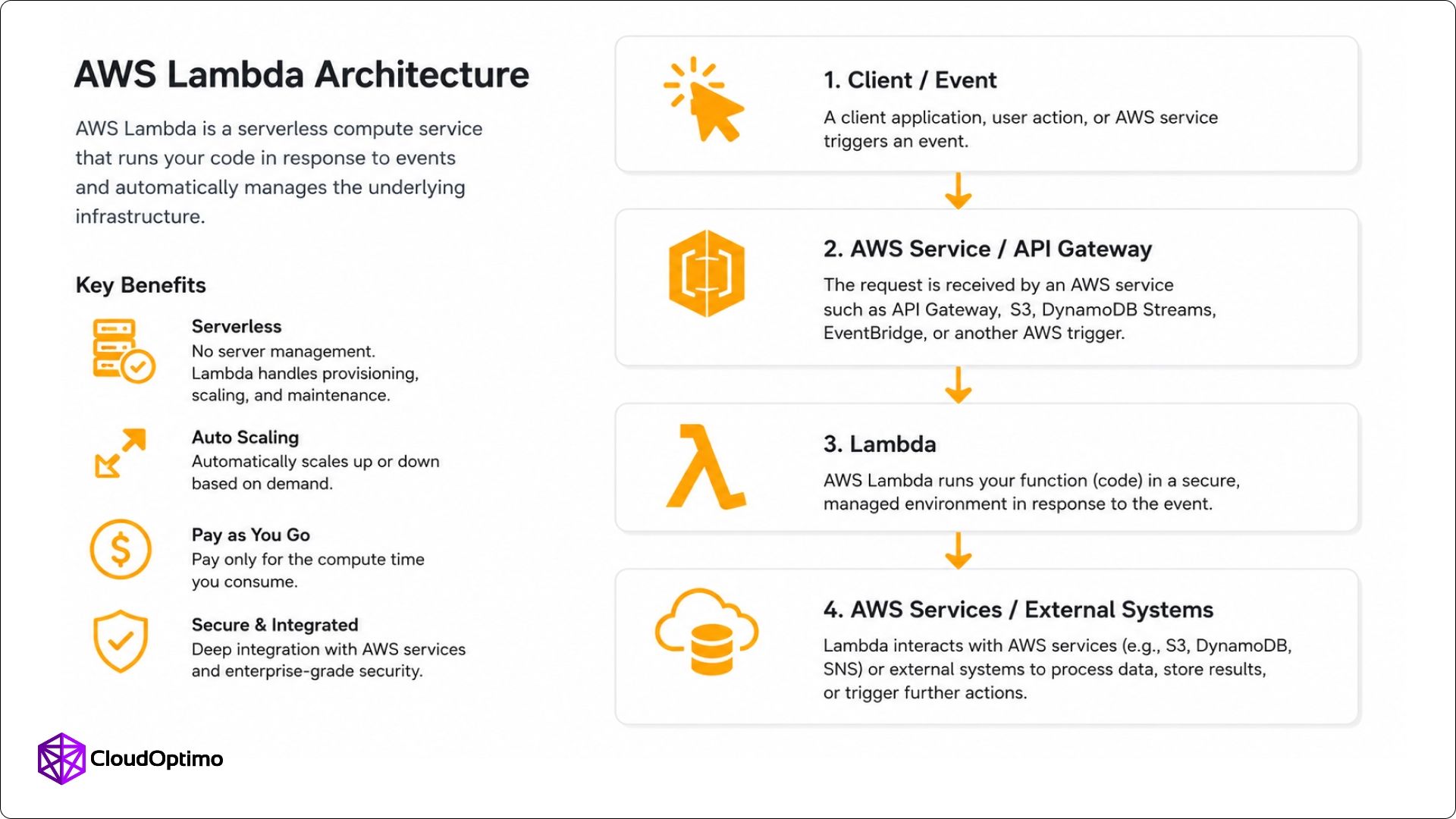
Figure : A simplified request flow through Client Event, API Gateway, Lambda Function, and AWS Services in a serverless cloud execution architecture.
Runtime and Application Compatibility
Runtime compatibility should be evaluated before selecting a serverless platform because the execution environment influences how existing applications can be migrated.
Cloudflare Workers uses a V8-based runtime with web-standard APIs and a Workers-specific execution model. Cloudflare supports modern application frameworks and languages including JavaScript, TypeScript, Python, and Rust.
AWS Lambda supports managed runtimes and customer-provided runtimes, allowing teams to execute application code in a range of supported programming environments. Lambda also provides execution options designed around functions and event-driven workloads.
This distinction becomes important for existing applications. Code that expects a traditional server process, operating-system access, or long-running execution may require architectural adaptation before moving to Workers. Applications already designed around AWS services and Lambda-compatible event patterns can often fit more naturally into the AWS ecosystem.
Cloudflare's current Workers platform also provides a broader set of application services around the runtime, including storage and database products, allowing developers to build applications without leaving the Workers environment.
The practical decision is therefore not simply about programming language support. Teams should evaluate application dependencies, runtime behavior, libraries, networking requirements, and how much adaptation the existing codebase requires.
Networking and Request Handling
Networking is one of the clearest architectural differences between the two platforms.
Cloudflare Workers is closely connected to Cloudflare's edge network, allowing request processing to occur across Cloudflare's distributed infrastructure. This model supports workloads such as routing, authentication, personalization, API middleware, content transformation, and other edge-side request processing.
AWS Lambda integrates with the broader AWS networking and service ecosystem. Lambda functions can respond to HTTP requests and events generated by AWS services, and can participate in architectures using services such as API Gateway, Amazon SQS, and Amazon EventBridge.
Network design also affects how serverless functions communicate with application dependencies. Workloads that access private databases, internal services, or origin infrastructure require appropriate connectivity between the execution environment and those dependencies. The resulting architecture depends on where the application services and data are hosted.
For distributed applications, request routing and network distance can influence end-to-end latency. The networking model should therefore be designed around the location of users, application services, and data rather than the compute platform alone.
Scaling and Performance
Both platforms provide managed scaling, but they use different execution models.
Cloudflare Workers is designed to run across Cloudflare's global network, with execution distributed across its infrastructure. Cloudflare currently documents no request limit on the paid Workers plan, while platform limits still apply to execution characteristics such as memory and CPU time.
AWS Lambda automatically creates and manages execution environments in response to demand and scales horizontally across invocations. Each execution environment processes one request at a time for standard Lambda functions, while concurrency controls can be used to manage workload behavior.
Performance should be evaluated beyond raw function execution speed. Network distance to databases, request payloads, storage access patterns, initialization behavior, and downstream service latency can all affect end-to-end response time.
End-to-end performance also depends on database access, storage operations, request size, initialization behavior, and downstream service latency.
Storage and State Management
Neither Workers nor Lambda should be treated as traditional stateful application servers. Persistent application state generally belongs in dedicated storage services.
Cloudflare provides multiple storage options around Workers, including KV, D1, Durable Objects, R2, and Hyperdrive, with each service intended for different data and application patterns.
AWS Lambda can work with a broad range of AWS storage and database services, including Amazon S3, DynamoDB, relational databases, queues, and other managed infrastructure. Lambda itself is designed around ephemeral execution rather than persistent local state.
The most important design decision is determining where application state should live and how functions access that state during execution.
| Requirement | Cloudflare Workers | AWS Lambda |
| Edge-oriented state | Durable Objects, KV | AWS services |
| Object storage | R2 | Amazon S3 |
| Serverless SQL | D1 | Amazon Aurora / RDS integrations |
| Persistent application data | External storage services | AWS storage and database services |
Storage selection should follow data access patterns, consistency requirements, geographic needs, and application dependencies rather than the compute service alone.
Security and Governance
Security in both platforms follows a managed-service model, but governance is closely tied to the surrounding cloud ecosystem.
Cloudflare Workers can integrate with Cloudflare's security and network services, including DNS, CDN, traffic control, and edge security capabilities. This allows security policies to be applied alongside edge application traffic.
AWS Lambda integrates with AWS Identity and Access Management and the broader AWS security ecosystem. Lambda functions can be governed through IAM permissions, resource policies, and service-level controls across the AWS environment.
For enterprise workloads, security should be assessed across the complete application path rather than the serverless function alone. Teams should review identity, secrets, data access, logging, network connectivity, and permissions for downstream resources.
A consistent governance model should also define who can deploy functions, which resources they can access, how secrets are managed, and how execution activity is recorded.
Cost Considerations
Cost is an important factor when comparing Cloudflare Workers and AWS Lambda, but the pricing model should be evaluated against actual workload behavior and the complete application architecture.
Cloudflare's Workers Paid plan has a $5 monthly minimum per account and includes 10 million requests and 30 million CPU milliseconds per month. Additional usage is charged based on requests and CPU time. Cloudflare also states that the Workers Paid plan does not charge separately for data transfer or bandwidth.
AWS Lambda uses a usage-based model that charges for function requests and execution duration. Compute duration is influenced by the memory configured for the function, and additional costs can arise from services used alongside Lambda, such as API Gateway, databases, storage, queues, logging, and data transfer.
This creates an important difference when estimating the total cost of a serverless application. Function execution may represent only one part of the monthly bill. For example, a Lambda-based API may incur costs from the API Gateway and its database in addition to Lambda execution, while a Workers application may incur costs from associated storage, database, or other Cloudflare services.
For Cloudflare Workers, the main usage considerations include request volume, CPU time, storage, and related Workers services. For AWS Lambda, teams should consider invocation volume, execution duration, configured memory, and the AWS services supporting the workload.
The most useful comparison is therefore the total cost of running the workload, rather than the price of executing the function itself. Workload architecture, data access patterns, request volume, execution time, and supporting services can all influence the final cost.
Cloudflare Workers vs AWS Lambda: Which Fits Your Workload?
There is no universal winner. The right choice depends on the workload's technical requirements, existing infrastructure, data location, and preferred operating model.
The following factors can help teams evaluate the two platforms:
| Workload Characteristic | Better Fit |
| Global edge API | Cloudflare Workers |
| Cloudflare-based web application | Cloudflare Workers |
| AWS event-driven backend | AWS Lambda |
| Heavy AWS service integration | AWS Lambda |
| Edge authentication or request processing | Cloudflare Workers |
| Existing AWS serverless platform | AWS Lambda |
Cloudflare Workers is generally a strong fit for applications that benefit from globally distributed edge execution, use Cloudflare services, or process requests close to users. Typical examples include edge APIs, authentication middleware, routing, personalization, and request transformation.
AWS Lambda is generally a strong fit for applications that rely heavily on AWS services, use event-driven workflows, or already operate within an AWS-based serverless architecture. Workloads connected to services such as S3, SQS, EventBridge, and other AWS components can align naturally with Lambda.
Storage and data location should also influence the decision. Applications already built around AWS-native databases and storage services may fit Lambda more naturally, while applications designed around Cloudflare's edge-oriented services may fit Workers more directly.
Existing security and governance requirements should also be considered when selecting between the two platforms. Teams should evaluate identity systems, access policies, and organizational controls alongside their workload requirements.
The decision should also account for the full application cost rather than function-level pricing alone. Compute, storage, databases, networking, observability, and supporting services all contribute to the total cost of operating a serverless workload.
The right platform is therefore the one that aligns most closely with the workload's execution model, surrounding infrastructure, data requirements, and long-term operating strategy.
Migration and Implementation Considerations
Moving an existing workload to either platform requires more than packaging the application and deploying it. The first step is to assess dependencies and identify components that rely on traditional server features, persistent local storage, long-running processes, or private network access.
For workloads moving to Cloudflare Workers, this may involve adapting Node.js-oriented code to the Workers runtime, moving persistent state to supported storage services, and redesigning server-specific functionality around edge execution. Runtime compatibility should be validated during the migration process.
For Lambda migrations, teams should evaluate function boundaries, event sources, concurrency behavior, and connections to AWS services. Lambda functions should be designed around independent, event-driven execution rather than treated as persistent application servers.
A pilot workload is often the most practical starting point. Select an application with manageable dependencies, validate networking and runtime compatibility, measure latency and resource consumption, and confirm security and observability before expanding the migration.
A structured migration approach helps teams validate the target architecture before applying it to larger workloads. Cloudflare Workers and AWS Lambda can both support production serverless applications, but implementation requirements differ according to their runtime models and surrounding ecosystems.
Frequently Asked Questions (FAQ)
1. We already have an AWS-based application with S3, SQS, and EventBridge. Should we consider moving the backend to Cloudflare Workers?
Not necessarily. If the application already depends heavily on AWS services, AWS Lambda may provide a simpler integration model because those services can invoke and work with Lambda directly. Moving the compute layer would also introduce migration and integration work that should be justified by a clear architectural benefit.
2. We have users across multiple regions, but our backend is hosted in one region. Would Cloudflare Workers help?
It can. Workers execute on Cloudflare's global network, which can place request-processing logic closer to users. However, if the Worker still needs to make frequent requests to a centralized database or origin, that downstream latency remains part of the application's end-to-end response time.
3. Can Cloudflare Workers sit in front of an existing AWS application without migrating everything?
Yes. Workers can be used as an edge layer while the existing application and backend services remain in AWS. This allows teams to introduce edge request processing, routing, or other logic without requiring an immediate full migration of the backend.
4. Our Lambda bill is low, but the total serverless application cost is increasing. Should we move to Workers?
Not automatically. Lambda execution is only one part of the architecture cost. API Gateway, databases, storage, queues, logging, and other AWS services can contribute significantly to the total bill. The same principle applies to Workers, where associated storage and other platform services also need to be considered. A platform change should follow a workload-level cost analysis rather than function pricing alone.
5. Can Cloudflare Workers and AWS Lambda be used together in the same application?
Yes. A hybrid design can use Workers for edge request processing, routing, authentication, or other edge logic while Lambda handles AWS-native backend workflows. This can be useful when different parts of an application have different execution, data, or integration requirements. AWS Lambda supports event-driven integrations with services such as S3, SQS, and EventBridge.

