
1. The Evolution of Orchestration: From Chaos to Control
A decade ago, deploying software was a relatively linear process. Applications were built as massive monoliths and deployed onto static, dedicated servers. However, as user demands scaled, this rigid architecture became a bottleneck. The industry's solution was containerization packaging applications into small, independent microservices that could run anywhere.
While containers solved the problem of portability, they introduced a massive new challenge: scale. A company was no longer managing ten servers; it was managing thousands of ephemeral containers scattered across various environments.
When a container crashed, who restarted it?
How did they communicate securely?
How could the system scale up during a traffic spike and scale down to save resources?
This chaos necessitated a new layer of infrastructure: the orchestrator.
Kubernetes emerged from Google’s internal systems to answer this call. It provided a unified, declarative platform to automate the deployment, scaling, and management of these containers. It was robust, powerful, and quickly became the undisputed industry standard.
However, as Kubernetes cemented its dominance, a secondary narrative began to unfold. For many organizations, the sheer scale and complexity of Kubernetes felt like using a sledgehammer to crack a nut. This opened the door for alternative philosophies, most notably HashiCorp Nomad a tool designed not to control the entire infrastructure universe, but to simply schedule workloads with maximum efficiency.
Understanding which tool to choose requires looking past the initial deployment and examining what happens when the dust settles.
2. The "Day 2" Reality: The Operational Tax
In enterprise software, "Day 1" is the deployment phase. It is the exciting period when a new technology is installed, configured, and turned on. However, the true measure of any infrastructure tool is "Day 2" the ongoing, indefinite lifecycle of maintenance, monitoring, upgrading, and troubleshooting.
This is where the concept of the Operational Tax becomes critical. An orchestrator is not a "set it and forget it" tool; it requires active engineering effort to keep it running smoothly.
With Kubernetes, the Day 2 operational tax is notoriously high. Kubernetes is not just a scheduler; it is a sprawling, interconnected ecosystem. For self-managed clusters, maintaining it means managing an intricate control plane and ensuring the health of the underlying etcd database. Many enterprises attempt to offload this specific burden by adopting managed cloud services like AWS EKS, Google GKE, or Azure AKS.
However, while managed services handle the master nodes, they do not eliminate the tax. Engineering teams remain responsible for configuring complex network meshes, securing Role-Based Access Control policies, managing worker node scaling, and navigating the aggressive release cycle. APIs are frequently updated or deprecated, requiring engineers to constantly audit deployment manifests to avoid breaking changes during mandatory cluster upgrades. The effort required to transition a cluster between versions can sometimes stall actual product development for weeks.
This heavy technical burden is the primary reason organizations look toward Nomad. When the sheer technical weight of maintaining the orchestrator outpaces the value it provides to the application layer, the platform has shifted from being a solution to being a bottleneck.
For decision-makers, evaluating an orchestrator means asking a fundamental technical question, do we have the engineering bandwidth to maintain the machine that runs our machines?
3. Architectural Philosophy and the Platform vs Component Debate
The reason the Kubernetes operational tax remains so high, even with managed services, stems directly from its foundational architectural choices. When evaluating how to manage this burden, decision-makers must look under the hood. Kubernetes and Nomad approach orchestration from two fundamentally opposed philosophies—the all-in-one platform versus the modular component.
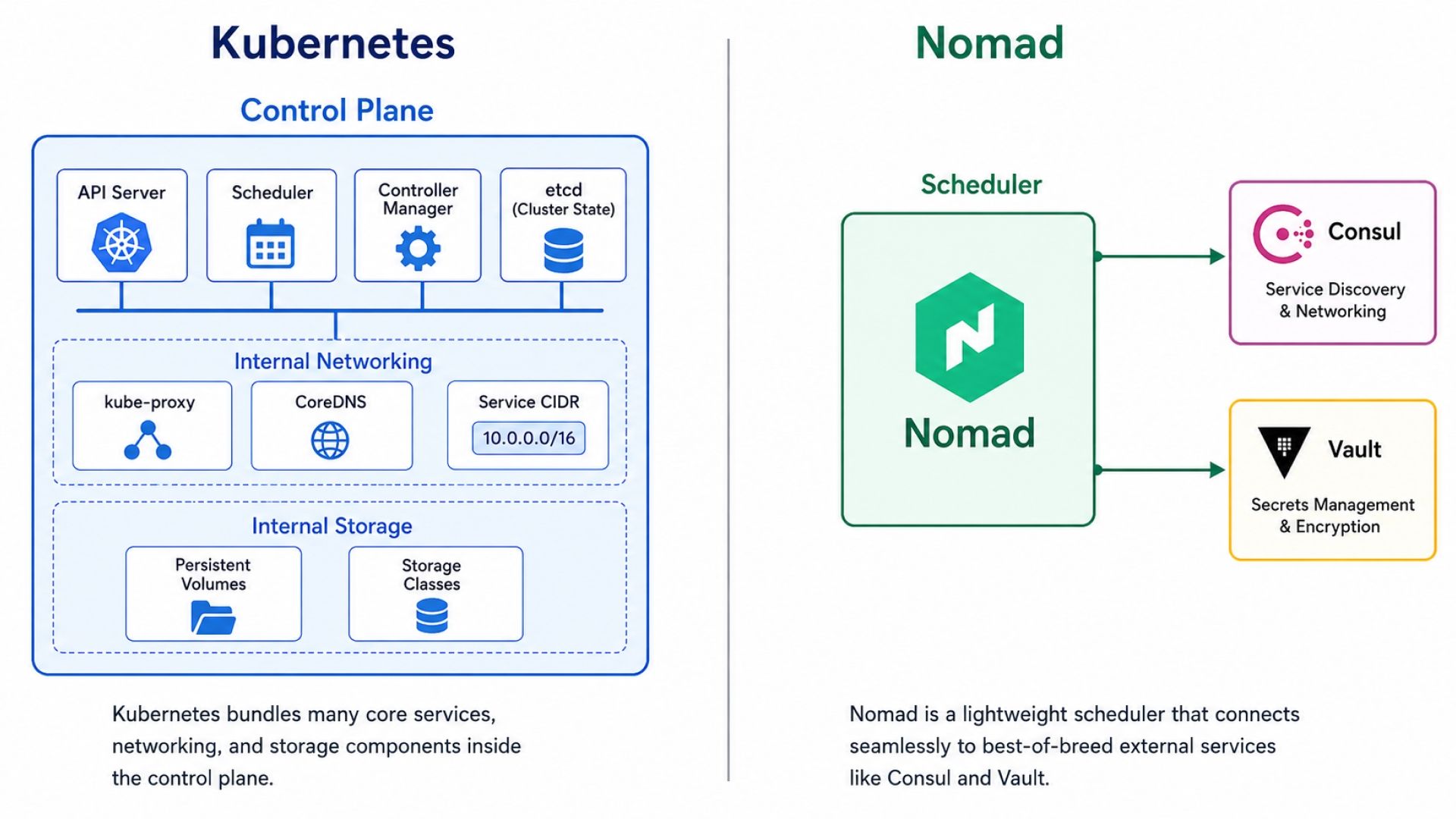
Kubernetes is designed as a comprehensive cloud operating system. Out of the box, it wants to dictate your entire infrastructure universe. However, it is often less "batteries-included" than advertised, adding to its complexity. Its architecture features an internal DNS, an Ingress API specification that requires installing third-party controllers just to route external traffic, and a Secrets API that stores data in plain base64, requiring immediate third-party hardening to be production-secure. For engineering teams, running Kubernetes requires maintaining a massive, interconnected state machine, which demands significant compute resources and highly specialized knowledge just to keep the platform secure and idling.
HashiCorp Nomad, conversely, is built strictly on the traditional Unix philosophy do one thing, and do it exceptionally well.
Nomad is not a platform; it is purely a workload scheduler delivered as a single, lightweight binary. It does not attempt to manage your network routing or store your passwords natively. Instead, it deliberately delegates those responsibilities to external, specialized tools, typically Consul for service networking and Vault for enterprise-grade secrets management.
This modularity means an organization can adopt Nomad without ripping and replacing their existing infrastructure. It offers a surgical, lightweight approach to orchestration, though it requires teams to wire together their own networking and security tools rather than fighting against the weight of a heavy, prescriptive platform.
4. Workload Flexibility: Containers, Legacy Code, and the Edge
These divergent architectures directly dictate what each system is capable of running, which is where the strategic migration path for an enterprise becomes sharply defined.
Kubernetes is primarily container-centric by design. It was the catalyst that forced the software industry to modernize, standardizing the use of OCI-compliant container runtimes across the industry. If an organization is building a greenfield application, deploying pure microservices, or running highly centralized AI inference workloads in the cloud, Kubernetes is highly effective. However, Kubernetes operates with a strong baseline assumption that your application should ideally be containerized. While extensions like KubeVirt allow Kubernetes to manage virtual machines alongside containers, its core architecture is undeniably built for a containerized world. For enterprises with decades of technical debt, forcing millions of lines of non-containerized legacy code into this paradigm is often a multi-year, multi-million-dollar roadblock.
| Workload Type | Kubernetes | HashiCorp Nomad |
| Docker Containers | Yes (Native) | Yes (Native) |
| Podman | Via Plugin | Yes (Official Driver) |
| Java JAR Files | No (Requires Container) | Yes (Native) |
| Windows IIS Applications | Yes (Windows Containers + Windows Nodes) | Yes (Native) |
| Raw Executables | No | Yes (Native) |
| Virtual Machines | Via Plugin (KubeVirt) | Yes (Native QEMU Driver) |
This is where Nomad serves as a pragmatic bridge. Because Nomad is simply a scheduler, it is fundamentally workload-agnostic.
Through its extensible task driver system, Nomad can orchestrate modern Docker containers right alongside legacy Java applications, Windows IIS web servers, and raw executables. A company can orchestrate a fifteen-year-old monolithic application without rewriting a single line of code.
Furthermore, this agnostic, lightweight nature makes Nomad a powerhouse for edge computing. While running a full Kubernetes cluster in a retail store's back office or on a resource-constrained IoT device is often financially unfeasible, Nomad can easily sit on a bare-metal server at the edge, silently scheduling workloads without the overhead of a massive cloud control plane.
5. Ecosystems and Governance or the Open Standard vs Corporate Stack
Kubernetes is the crown jewel of the Cloud Native Computing Foundation. Its governance is entirely open-source, community-driven, and insulated from the unilateral decisions of any single corporation. Choosing Kubernetes means tapping into the largest, most standardized infrastructure ecosystem on the planet. If an enterprise needs a service mesh, monitoring dashboards, or package management, there is a heavily supported, plug-and-play solution readily available. Every major cloud provider offers a managed Kubernetes service, which provides a level of vendor neutrality that is difficult to match.
Nomad offers a tighter, highly curated ecosystem. It is designed to integrate flawlessly with HashiCorp broader portfolio, specifically Consul for service networking and Vault for dynamic secrets management. This unified stack is elegant, secure, and highly functional out of the box. However, the governance landscape for Nomad has shifted significantly.
Following the acquisition by IBM and the transition to a Business Source License, Nomad moved away from traditional open-source models. While this does not restrict standard internal enterprise deployment, it changes the risk profile for organizations concerned about corporate control. Operating Nomad today means aligning your long-term infrastructure strategy with the IBM product roadmap. For some enterprises, the promise of strong, corporate-backed support is a major asset. For others, the lack of foundation-led governance is viewed as a strategic vulnerability.
6. Financial and Human Capital and the True Cost
Infrastructure costs are divided into two distinct ledgers i,e the compute bill and the engineering payroll.
On the compute side, Kubernetes requires a substantial baseline investment. A highly available control plane consumes significant CPU and RAM before a single business application is even deployed. If utilizing a managed cloud service, the financial model varies significantly by provider. AWS EKS charges a fixed hourly fee (~$0.10/hour per cluster) simply for the control plane to exist. Google GKE follows the same model beyond its first free cluster per billing account. In contrast, Microsoft Azure AKS absorbs this cost entirely for its standard tier, offering the control plane for free. However, regardless of the provider, there is always an added compute "tax" for running logging, networking, and security agents on every worker node.
Nomad is famously resource-efficient. Its single-binary architecture demands minimal overhead, allowing organizations to achieve higher container density and run workloads on cheaper, less powerful hardware. Because it lacks a heavy control plane, Nomad is often the more cost-effective choice for smaller clusters or multi-region deployments where the per-cluster fees of managed Kubernetes would quickly accumulate.
Regarding human capital, the disparity is equally sharp. Kubernetes is a complex system that requires specialized expertise. Organizations must hire dedicated Platform Engineers or Site Reliability Engineers, who command premium salaries just to manage upgrades and maintain cluster health. Nomad, due to its operational simplicity, can often be managed by generalist developers or a lean DevOps team. The learning curve is measured in days rather than months, significantly lowering the payroll required to keep the platform running.
| Metric | Kubernetes | HashiCorp Nomad |
| Control Plane Overhead | High (Heavy etcd/API server footprint) | Minimal (Single lightweight binary) |
| Managed Service Costs | Varies (~$0.10/hr on EKS/GKE, Free on AKS) | Low (Typically self-managed on raw VMs) |
| Engineering Expertise | Specialized SREs | Generalist DevOps |
| Operational Payroll | High (Dedicated platform team required) | Low (Generalist engineering support) |
7. The Verdict: Aligning the Tool to the Reality
The choice between Kubernetes and Nomad is not a matter of selecting the objectively "better" technology; it is an exercise in aligning an orchestrator with an organization's engineering reality, legacy constraints, and budget.
Kubernetes won the orchestration war by becoming the default API for the cloud, but that victory came with a heavy operational tax. It is worth noting that managed services like EKS, GKE, and AKS absorb a meaningful portion of that tax by handling control plane management on your behalf. However, they do not eliminate it entirely. RBAC, network policy, application-level upgrades, and node management still fall squarely on your engineering team, and the per-cluster cost model compounds quickly in multi-region deployments.
Nomad survives and thrives by offering an escape hatch from that complexity, serving as a pragmatic bridge between legacy data centers and modern application deployment. Its value is not that it outperforms Kubernetes at its own game it deliberately does not try to. Its value is that it solves a narrower problem with far less operational weight.
To simplify this critical decision, one can rely on the following strategic matrix:
| Strategic Driver | Choose Kubernetes If... | Choose Nomad If... |
| Workload Profile | Your applications are primarily containerized, utilizing pure microservices or complex AI/ML pipelines. | You operate mixed workloads, requiring containers to run alongside legacy Java applications, raw executables, or VMs. |
| Ecosystem & Tooling | You require the broad integrations and standardized tooling provided by the CNCF landscape. | You already utilize or prefer the tightly integrated HashiCorp stack (Vault, Consul, Terraform). |
| Infrastructure Scale | You are managing large, centralized cloud deployments and prefer managed services (EKS, GKE, AKS). | You operate lean multi-cloud setups, multi-region deployments, or resource-constrained edge and IoT environments. |
| Engineering Team | You have or can hire dedicated Platform Engineers and SREs to manage the platform's ongoing complexity. | You are working with a lean DevOps team or generalist developers who cannot absorb a steep, ongoing operational burden. |
| Governance Posture | You mandate purely open-source, community-driven platforms governed by the Linux Foundation and CNCF. | You are comfortable with corporate-backed IBM/BSL licensing and prefer the accountability of enterprise support. |

