
Modern infrastructure becomes difficult to manage long before an organization reaches significant scale. Resources get created manually, server configurations drift over time, and environments gradually become harder to reproduce. As infrastructure grows, these challenges increase the operational effort required to keep systems reliable and consistent.
Terraform and Ansible address different parts of this problem. Terraform focuses on provisioning and managing infrastructure as code, while Ansible automates server configuration. Used together, they make infrastructure more consistent, repeatable, and easier to manage.
1. Manual Infrastructure Provisioning and Terraform State Management
Problems with manual provisioning. Many environments start with manual actions: an engineer creates a VPC, configures subnets, launches instances, and adds security rules through a console. It works initially, but reproducing that environment later means remembering every decision that was made. As more environments get created this way, small differences between staging and production, or between resources built by different engineers, go unnoticed until they affect a deployment.
Repetitive work and human errors. Building similar infrastructure for another environment or region means repeating the same manual steps, and repetition is where mistakes creep in. A wrong instance size or missing security rule rarely fails immediately; it surfaces later as an inconsistency nobody can trace. Infrastructure as code solves this by defining infrastructure in version-controlled configuration files that can be reviewed and reused, letting Terraform describe the desired infrastructure instead of the steps to create it.
Defining infrastructure as code with Terraform. The real benefit isn't that Terraform creates resources automatically, it's that infrastructure's intended configuration now exists as code: stored in Git, reviewable before changes apply, and reusable across environments. But once infrastructure is code, a new requirement appears: Terraform needs to know what it has already created.
Understanding Terraform state. Terraform tracks this through a state file, which maps the resources in your configuration to what actually exists. If state is missing, outdated, or mismanaged, Terraform's view of infrastructure becomes inaccurate, resulting in unexpected changes or resources being handled incorrectly.
State locking and team collaboration. State management matters even more once multiple engineers work against the same infrastructure. Keeping state only on individual machines makes concurrent changes risky and can lead to inconsistent state management. Teams instead use a shared remote backend with locking and access controls, turning state from a local concern into part of the team's workflow.
Remote state and backends. In practice, this means moving state off individual laptops and into a shared remote backend. For example, the Amazon S3 backend supports native state locking through the use_lockfile option, while HCP Terraform provides managed remote state, collaboration, access controls, and Terraform execution capabilities. Using a shared backend ensures that engineers and automation pipelines work from the same source of truth while reducing the risks of concurrent state changes.
Detecting drift with terraform plan. Infrastructure can still change outside Terraform, someone patches something manually during an incident, and code and reality disagree. terraform plan surfaces that gap before it turns into a bad apply, giving teams a chance to decide whether the change belongs in code or should be reverted.
2. Configuration Drift and Server Inconsistency
How drift occurs. Provisioning infrastructure consistently doesn't guarantee the servers running on it stay consistent. Drift usually starts small: an engineer SSHs into a server during an incident, installs a package or edits a config file, and that change never makes it into the automation. Multiply this across months and engineers, and servers that started identical slowly diverge.
Differences between servers and environments. The same pattern shows up between environments. Staging quietly falls behind production, or a package version differs between two servers. Teams end up spending more time locating the difference than fixing the actual bug.
Problems with manual configuration. This is the same core issue as manual provisioning, at a different layer: provisioning determines whether servers exist, configuration determines what's running on them. Doing this by hand across a growing fleet leaves no assurance the same steps were applied everywhere.
Ansible idempotency. Ansible solves this by letting teams describe desired configuration rather than steps. Its key mechanism is idempotency: a task run repeatedly produces the same result each time. If a server already matches the desired state, running the playbook again makes no changes, which makes automation safe to repeat across any number of machines.
Using Ansible to maintain consistency. The same playbook applied across a group of servers keeps required packages, services, and files aligned. This doesn't prevent manual changes from happening after a playbook runs, but it does mean the desired state is documented and executable, so instead of relying on memory, teams can repeatedly bring systems back toward the intended configuration.
3. Scaling Infrastructure and Reproducing Environments
Challenges as environments grow. The problems in Sections 1 and 2 don't stay the same size as infrastructure grows, they compound. Provisioning a few servers manually is inconvenient; provisioning dozens across multiple regions is a different problem entirely. Scale doesn't necessarily create new problems, it just makes manual solutions impractical.
Provisioning multiple resources consistently. Terraform's declarative approach handles this directly. Features like count, for_each, and variables create multiple resources from a common configuration while still allowing intentional differences, reducing the risk of resources being configured differently simply because they were built at different times.
Configuring multiple servers automatically. Ansible provides the equivalent on the configuration side. A playbook targets individual hosts or groups through an inventory, and the same automation applies to one server or a hundred. Adding new servers is a matter of placing them in the right inventory group, not writing new automation.
Recreating dev, staging, and production. Reproducibility is a key payoff of managing infrastructure as code. Environments don't need to be identical, staging and production can intentionally differ in instance size or region, but those differences become explicit variables rather than the result of undocumented manual changes. If an environment needs rebuilding, the same Terraform configuration and Ansible playbooks can recreate it instead of reconstructing it from documentation or memory.
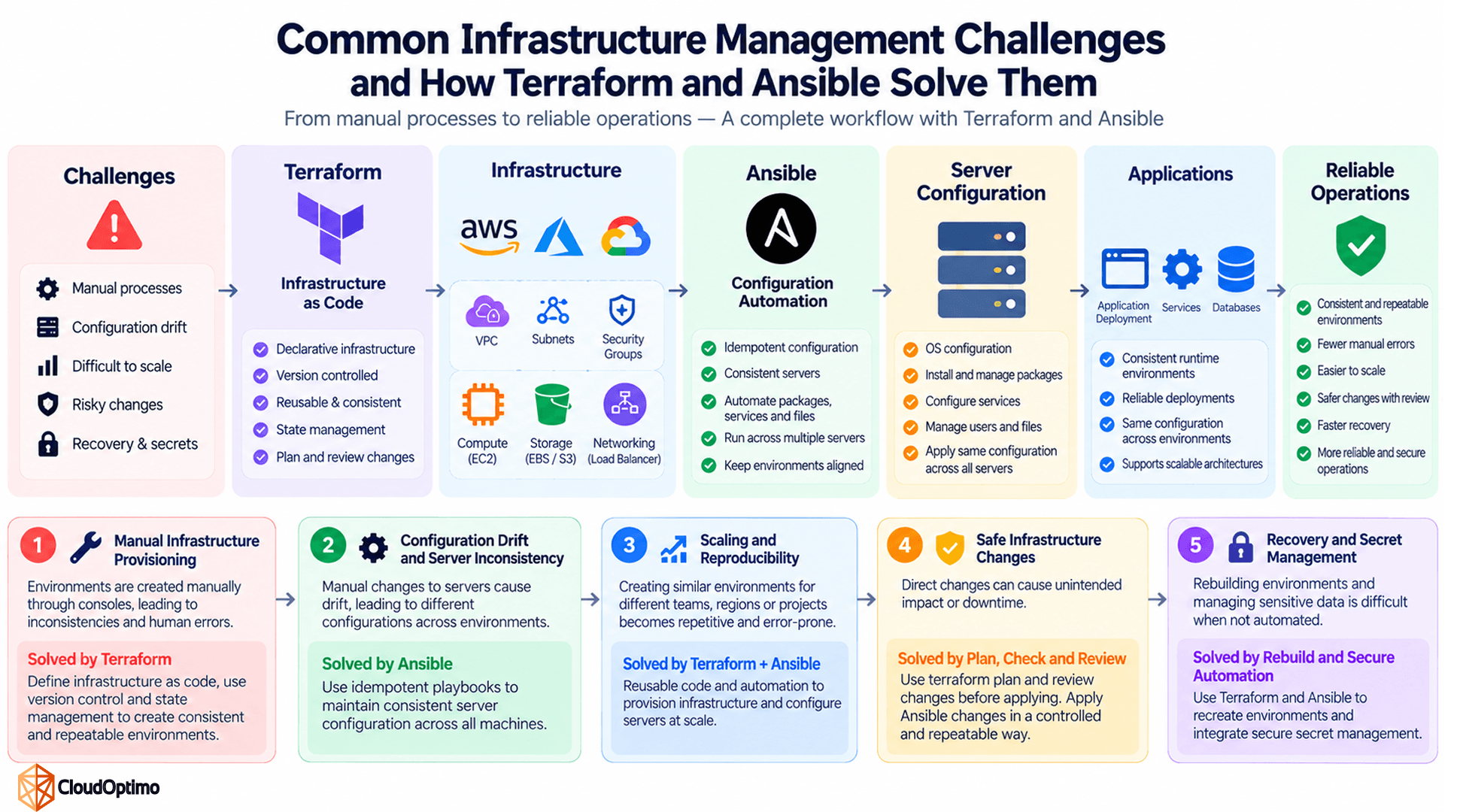
Terraform and Ansible working together. At scale, the roles of each tool become clear: Terraform provisions infrastructure, Ansible configures what runs on it, and applications deploy on top. A typical workflow looks like:
Terraform provisions the infrastructure → Ansible configures the servers → Applications are deployed.
Keeping these responsibilities separate lets each tool focus on the layer it's built for, producing environments that can be built, rebuilt, and scaled from the same source every time.
4. Infrastructure Change Management and Safe Updates
Risks of manual changes. Provisioning and configuration are only part of the picture. Running systems need continuous changes, security rules, instance sizes, software versions, and manual changes to a live environment carry real risk. Without a review step, an incorrect setting often isn't visible until after it's applied.
Version controlling infrastructure and configuration. Storing Terraform configurations and Ansible playbooks in version control gives every change a clear history: what changed, who proposed it, and why. Instead of editing something directly through a console or SSH session, an engineer modifies the configuration and submits it for review.
Reviewing changes before applying. Version control makes review possible, but the review itself is what catches problems, an exposed port in a security rule, a change that unexpectedly replaces a resource, a task that restarts a service nobody intended to touch. Making the change visible before it executes is what makes it correctable.
Terraform plan and Ansible check mode. Terraform's terraform plan shows exactly what will change before anything is applied. Ansible offers the same idea through --check mode, often paired with --diff, previewing configuration changes without making them. Both support the same principle: understand the effect of a change before committing to it. Treating these previews as a required part of the review process, not an optional one, makes production updates far more predictable.
Rollback and traceability. Version-controlled infrastructure makes recovering from a bad change far easier. If a change causes a problem, the previous version is still in the repository, and teams can identify what introduced the issue and restore it. Not every resource can be rolled back with a single command, some involve external dependencies or data, but version control provides the history needed to understand and respond to the change.
Code review and approval workflows. At team scale, this becomes a formal workflow: changes proposed through pull requests, previewed with plan output or check-mode diffs, reviewed, and only then applied to production.
5. Infrastructure Recovery and Secure Automation
Challenges of rebuilding after failures. Failures happen regardless of how carefully systems are managed, resources get deleted accidentally, configurations break, environments need rebuilding after an outage. When infrastructure was built manually, recovery depends on documentation and whoever remembers how it was originally set up, which makes recovery slow and error-prone under pressure.
Recreating infrastructure from Terraform code. If an environment's network and compute resources are defined in Terraform, rebuilding it is a matter of using those same definitions rather than reconstructing anything from memory. Accurate state remains essential here, Terraform needs to know what already exists, especially when only part of an environment needs rebuilding.
Reconfiguring servers with Ansible. Recreated infrastructure still needs software, configuration, and services installed. Ansible applies the same playbooks used in normal operations to the newly provisioned servers, so there's no separate set of manual recovery instructions to maintain.
Automating recovery workflows. Together, this forms a repeatable recovery path:
Terraform recreates infrastructure → Ansible configures the servers → Applications and services are restored.
The real advantage is that recovery can be tested before an actual incident. Running the same steps against a temporary environment surfaces missing dependencies or outdated configuration well before a real outage forces the issue.
Managing credentials and secrets securely. Automation introduces its own risk: infrastructure code and playbooks often need database passwords, API keys, and certificates, and hardcoding these into version-controlled files creates unnecessary exposure. Secrets need to be handled separately from ordinary configuration.
Protecting secrets in Terraform and Ansible. Terraform's sensitive values keep secrets out of command output, but that's a display safeguard, not secure storage, teams still need a proper secrets-management system and controlled access to state, since state itself can contain sensitive data. Ansible Vault encrypts sensitive variables so they can live safely in the same repository as everything else, and can integrate with external secrets systems for more centralized credential management. Secure secret handling should be part of the automation from the start, not an afterthought added once everything else is working.

